Chapter 3

THE STANDING POSES  

The safest way to develop, strength during pregnancy is to practice yoga’s standing postures. Exercise during pregnancy must create strength as well as flexibility. The standing poses stretch and strengthen. 

The standing poses are easily adapted for each trimester of pregnancy. They may be performed with the aid of a wall or chair during the third trimester. Inactivity produces lethargy, standing poses develop vigor. They create energy because they increase circulation. These yoga poses expand the rib cage, deepen breathing, and develop stamina. 

Muscle cramps are common in pregnancy. Regular practice of the standing poses may help relieve leg cramps by increasing circulation in the legs. During pregnancy the additional weight of the uterus places added stress on the lower back. In any activity if the legs and hips are tight, the lower back must do more of the work. Stretching hip and leg muscles in the standing poses creates the mobility which lessens the stress on the lower back. 

Standing postures create strong legs. As legs become stronger, leg fatigue lessens. Strong legs help position the pelvis and spinal column correctly. When the pelvis is positioned in a balanced way, there is less strain on the back. Strong legs and back are necessary to support the growing uterus. 

It is the combination of strength and flexibility which takes the strain off the back in pregnancy. Practicing standing poses creates this healthful, pain-free balance. 

Hints And Cautions

Standing poses are strenuous and should not be held for a long time. During the first trimester, many pregnant women experience periods of fatigue and dizziness. Energetic standing poses would not be appropriate at these times. 

In the third trimester, vigorous wide leg standing postures may place too much weight and pressure on the pelvic floor. The same postures may be performed safely using a chair for support. 

During pregnancy a hormone called relaxin is secreted. This hormone has a loos- ening and softening effect on the ligaments. For this reason it is important not to overstretch when exercising. Overstretching ligaments may cause unstable joints. Relaxin may effect the sacroiliac joint and create discomfort in the standing pos- tures. 

One or both of the legs are kept straight throughout the following poses. It is important to learn how to correctly straighten the legs in order to create the maximum possible stability. Bend your knees slightly and place your fingers on your kneecaps. Tighten your front thigh muscles, the quadriceps, and feel the kneecaps lift. Maintain this lifted position whenever a pose calls for straight legs. 

Tree Pose

Stand with back to wall and feet a few inches from wall. Transfer weight to right leg. Bend left knee and place left foot firmly on inside of right thigh or knee. Left toes point straight downward.

Extend arms and place fingers on wall for support. Lift kneecap and thigh muscles of right leg. Balance weight evenly on right foot.

Stretch chest, sides of body, and right thigh upward. If balance is secure, release fingers from wall and stretch arms above head. Look straight ahead. 

Release, lower leg and arms. Reverse pose bending right knee and balancing on left leg.

Tree pose improves balance and strengthens legs. 

Eagle Pose

Stand with back to wall and feet a few inches from wall. Extend arms and place fingers to wall.

Bend left leg with knee pointing straight ahead. Wrap right leg over left thigh and, if possible, hook toes behind left calf muscle.

Lift the chest and balance body evenly over left leg. With fingers to wall for sup- port, bend left knee and lower body slightly. Slowly straighten leg and release. 

To reverse pose, bend right leg, wrap left leg over right thigh and around right calf. Release pose, stand upright, and rest lower back to wall.

This posture stretches hip muscles, strengthens thigh muscles, prevents calf cramps, and improves balance. 

Alternate Leg Stretch With Chair

Place chair 4 to 5 feet away from wall. Stand with back to wall, position left heel to wall, and extend right foot 3 feet from wall. Left toes turn in slightly, and right toes point straight ahead.

Place hands on hips and adjust left hip forward until both hips are parallel to chair. Inhale and lift chest. Exhale and bend forward at hips keeping back straight.

Stretch arms forward and hold top of chair back. With each exhalation, stretch backs of legs by drawing up front thigh muscles and lifting buttock bones.

When pose becomes easy, push chair forward, and stretch until chest is parallel to floor. Release and reverse with left foot forward. 

This pose stretches backs of legs, shoulders, and back. 

Standing Alternate Leg Stretch

Stand with back to wall. Place right heel to wall and take a 3-foot step forward with left foot. Align hips, lift thigh muscles, and point left toes straight forward.

Press palms together behind back. Rotate hands until fingers point upward. In-hale and straighten legs. Exhale, bend forward at hips, and keep back straight.

Tilt buttock bones upward and stretch breastbone forward until back is level with floor. Breathe normally and elongate spine with each exhalation.

Release and reverse legs. After completing both sides, rest with back to wall and arms relaxed at sides. 

This pose loosens tight shoulders and wrists, stretches leg muscles, and improves posture.

Triangle Pose

With right heel to wall, widen legs 3 to 4 feet apart. Turn left foot out 90 degrees. Align heel of left foot with arch of right foot. Rotate straight left leg outward to bring top thigh, knee, and foot in line.

Press in with left hand at top of left thigh, tilt pelvis, and stretch upper body side- ways to left. Keep both sides of torso evenly stretching. Lower left hand to left shin.

Create firmness in legs and continue to extend left ribs laterally. On an exhalation stretch right arm vertically, rotate right hip and shoulder upward, and look toward right hand. Breathe normally.

Release pose, change legs, and stretch to right. 

This pose strengthens legs, elongates spine, and stretches outer hip and inner thigh muscles.

Warrior II Pose To Wall 

Place right foot to wall and widen legs 4 to 4 1/2 feet apart. Turn left foot out 90 degrees, and align heel of left foot with arch of right foot. 

Keeping right leg straight, bend left knee until left thigh and shin bones create a right angle. Hold left knee back with left hand, and tuck tailbone under. 

To increase stretch across front pelvis, pull right hip back with right hand. Lift top chest, release hands from hips, and lift and extend arms straight out from shoulders. Hold this strenuous pose for a short time.

Release pose, reverse legs, and bend right knee. After completing both sides, rest with back to wall.

This pose opens groin area, strengthens legs, and creates endurance. 

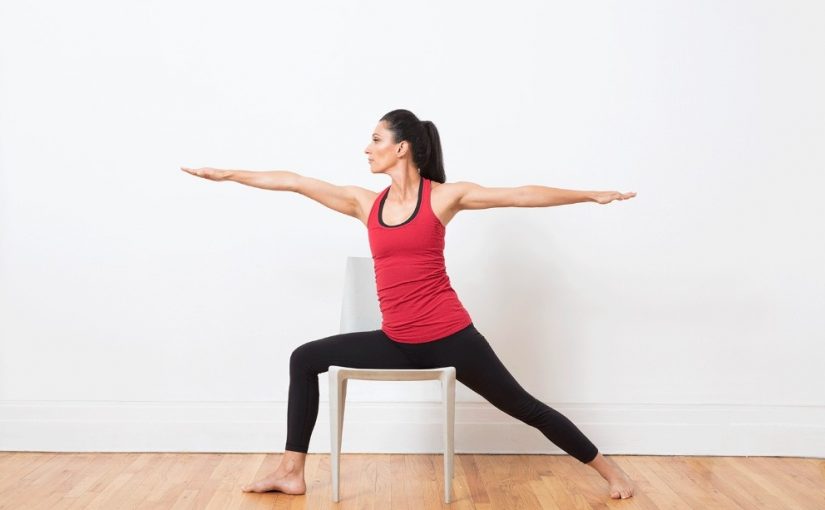
Warrior II Pose With Chair

Place chair to wall. Sit on chair with right buttock supported by chair seat. Bend right knee and align inner right thigh with front edge of chair seat.

Extend left leg on floor and turn toes in slightly. Line up right heel with arch of left foot. Right toes point straight ahead and thigh and shin are perpendicular.

While maintaining alignment of inner right thigh, stretch groin area by pulling back left hip. Lift both sides of chest evenly, relax shoulders, and tuck tailbone under. Breathe normally while stretching. 

Release and repeat pose to left. Complete both sides and rest sitting in chair with knees together.

This pose stretches groin and inner thigh muscles. 

Extended Warrior II Pose With Chair

Place chair to wall. Sit on chair with left buttock supported by chair seat. Bend left knee and align inner left thigh with front edge of chair seat.

Extend right leg on floor and turn toes in slightly. Line up left heel with arch of right foot. Left toes point straight ahead and thigh and shin are perpendicular.

Raise arms and extend them straight out from shoulders. Lift breastbone and roll shoulders back and down. Turn head and look over left arm. Maintain even stretch of groin muscles and sides of body.

Release, change legs, and do pose to right. Complete both sides, lower arms, and rest sitting in chair.

This pose strengthens arms and improves posture.